Once the nation’s epicenter in the real estate collapse Miami, Florida condo sales are soaring, up 43% over year ago levels, according to the Miami Association of Realtors. The Miami housing market has now experienced rising sales for nearly two straight years.
Miami ’s condominium market tanked even before the financial crisis struck Wall Street two years ago as New York based hedge funds and banks cancelled financing agreements on dozens of new condo developments being constructed. The new construction condo market almost froze, nearly paralyzed as a result, triggering a plunge in prices forcing many developers into bankruptcy.
But the rise in condo sales is breathing new life into the Miami housing market. “Demand for local properties, including multiple bidding reminiscent of the boom during the last decade is driving values,” said Miami Realtors President Oliver Ruiz. “Median and average sales prices are rising, while condominium prices are expected to follow due to the considerable increase in sales.”
The time it takes to market a home for sale dropped to 100 days for single family homes and 114 days for condominiums, showing that the market is nearing stabilization, despite declining condo prices.
However, the market isn’t without its challenges. Sales of existing single family homes dropped 8% in July from year ago figures, indicating the market is anything but fully stabilized. But record low mortgage rates and some of the lowest priced condos for any metropolitan region in the country should usher in a robust return in sales over the remainder of the year. Residential sales have increased for 23 straight months.
Even as home sales sank in the majority of the country by 27.2% in July, according to the National Association of Realtors, Miami and the rest of Florida condo sales increased. The median sales price for a condo in Miami in July was $110,500 down 20% from a year ago as bargain hunters bought up condos at some of the lowest prices in more than 15 years. Florida median sales prices declined 7% to $138,000 for single-family homes.
The inventory of residential listings marketed by the Miami-Dade County Realtors association dropped 11.4% from July of 2009, indicating that the market is showing strong signs of finally entering the recovery phase after record housing deflation. Average home sale prices are rising after hitting 30-year low values in many single family home neighborhoods. But lower prices obtained for condos still hurt the overall market.
Source: http://www.housingpredictor.com/miami-condo-sales-soar.html
By Kevin Chiu
The Criscitos has been selling South Florida luxury and commercial real estate for over a decade and has sold over $1 billion dollars of property. They work as a multi-lingual team speaking english, Spanish, Italian and Portuguese. They carved out a niche as a leading boutique real estate company with two distinct divisions -residential and commercial- both personally overseeing by Marcela and Anthony Criscito.
Showing posts with label sales. Show all posts
Showing posts with label sales. Show all posts
Wednesday, August 25, 2010


Friday, July 9, 2010
Miami Beach Luxury Real Estate Gets Cheaper as Short Sales Abound
Finding a "cheap" mansion on Miami Beach has become easier in the last few years due to the yo-yo-ing real estate market. That is, if you consider $3 million to be cheap. A few years ago, many of the properties on millionaire-row streets like North Bay Road and Palm Avenue were untouchable by many well-to-do buyers. Now those priced at $12 million and $13 million have dropped to $9 million, while those at $6 million are now priced at $3 million.
Ironically, wealthy all-cash buyers may ultimately rescue the deeply depressed local housing market.
"We definitely see affordable mansions happening all over, but especially in our waterfront properties, where the most desirable mansions are located," says Esther Percal, a Realtor with Esslinger, Wooten, Maxwell who has made a career of selling luxury real estate on Miami Beach.
She's referring specifically to North Bay Road where unobstructed, bay-front homes range near 14,000 square feet, with 80 feet of waterfront.
These lower prices are a 40 percent reduction from what these homes cost when the market was booming. Taking advantage of the affordability are interested buyers who had been hovering around Miami Beach looking for a home, but were unable to purchase. Now is their time. In the centrally located Venetian Islands, which are walking distance to South Beach, homes can be bought for between $1 million and $1.5 million, an affordable price considering that most are 10,500 square feet with 65 feet of waterfront.
Celebrities are not immune to these lower prices, with NBA Star Shaquille O'Neal taking a hit on his two-story Star Island home. He originally purchased the 20,000-square-foot, eight-bed, nine-and-half-bath house for $18.8 million in 2004 and sold it to a Russian buyer in June of 2009 for $16 million. He had originally put the two-acre parcel at 26 Star Island Drive on the market for $32 million, and he got a higher offer at first. But O'Neal ended up with a loss while the European got a sweet deal.
With Miami being a playground for the rich, most of the buyers -- some 60 percent of them -- are part-time residents (mostly Europeans and Northerners) and they're buying with all cash. "These folks have wanted a piece of the beach for a while but a few years ago even non-waterfront property was $1 million and now that's down to $500,000, meaning we are no longer untouchable as we once were," Percal says. Besides, dealing with the banks and any kind of financing is a nightmare, since everything is down in appraisals and banks. The all-cash deals are not subject to financing.
All these facts and figures are indicators of a possible slight turnaround in the market. Sales have been so strong in the past two years that good deals are getting harder to find. "Turning the market around is a matter of absorption and we're seeing that. Where once we had an 18-month inventory it's now down to a 14-month inventory, so there's market absorption," she said.
So it may be that, in the long run, these cash buyers will be partly responsible for rescuing the housing market.
Wouldn't that be something?
Source: http://www.housingwatch.com/2010/07/08/miami-beach-luxury-real-estate-gets-cheaper-as-short-sales-aboun/
By Josie Gulliksen
Monday, June 21, 2010
LUXE SALES BUZZING
Cristina Miranda never wanted to live in a condominium but after she walked into one at the Gables Club with sweeping views of the sparkling Biscayne Bay, Fisher Island and the Miami skyline, she changed her mind.
With no regrets, Miranda sold her Coral Gables house of 30 years that she had shared with her now late husband, and bought the nearby condominium for $2.5 million in March.
``I always said I was going to die in my house,'' Miranda said, taking in her new view from the 5,200-square-foot condo. ``But when I saw this, I fell in love with it.''
Miranda's purchase is part of what some real estate experts are calling a ``miniboom'' in high-end condo sales in Miami-Dade County this year.
Countywide, 135 condos priced at $1 million or more sold during March, April and May this year, almost doubling the number of units in that price range that sold during the same period in 2009, according to Esslinger-Wooten-Maxwell, one of the largest real estate brokerages in Miami-Dade and Broward. In Broward, 17 $1 million-plus units sold during that time period this year compared to 12 last year.
The superluxury condo market is taking off too: in the past month there were four sales breaking the $7.5 million mark. Units sold for $8.7 million at One Bal Harbour; $9 million at the Fountainebleau; $11 million at the Santa Maria Brickell; and $15 million at the Setai.
Those four sales alone have the real estate industry abuzz, considering that there was only an average of 2.5 sales of condos in that stratospheric price bracket for the past eight years, according to EWM.
``We are selling more units right now because people are sensing we are at the bottom of the market,'' said Ron Shuffield, president of EWM. ``And there aren't that many to choose from, especially in the penthouse range.''
The unit that sold at Santa Maria Brickell for $11 million in foreclosure was priced at $14 million three years ago, Shuffield said. ``I think people are realizing you cannot reproduce any of these buildings for what we're selling them for.''
This month, a penthouse at the Marquis Residences sold for $4.2 million, said Lori Ordover, managing director for sales and leasings at Africa Israel USA, the developer of the building.
The four-story, 7,800-square-foot penthouse topping the 67-story building at 1100 Biscayne Blvd. claims the highest terrace and hot tub in Florida, and is one of seven units that sold for more than $1 million since March.
Ordover said the sales team had not yet priced the unfinished condo, which was sold in raw condition without the finishings (floors, window treatments, etc), and was not yet on the market when a buyer showed up with a ``good price.''
Ordover said most luxury condo buyers are paying in cash and they are buying units to live in, rather than as a pure investment.
``It's like the tide is starting to turn,'' Ordover said. ``I see the energy. I see more people coming to look in the sales office, double the number from last summer.''
For sure a major draw of the luxury condo communities, which began coming on the market in the mid-1990s, is the array of amenities that they offer. Some developments offer glamorous living experiences, with zen gardens, luxury spas, oceanside pools, private butler services, and exclusive club memberships.
At the Marquis Residences, owners can have a chef from its boutique hotel cook them a gourmet meal in their condo. The Setai in Miami Beach, 2001 Collins Ave., offers private plane and yacht charters. At Apogee, 800 South Pointe Dr. in Miami Beach, each unit has a privately-enclosed two-car garage on the parking levels.
Real estate experts say the luxury condo market should only get stronger because condominium living is an increasingly popular lifestyle choice for the wealthy.
In fact, according to Shuffield at EWM, this past quarter is now the third quarter of the last eight quarters where there have been condo sales exceeding single-family home sales for properties priced greater than $1 million.
Though the numbers for that price range are still close -- an average of 39 single family homes per month sold during the first quarter of 2010 vs. an average of 45 condos during the same time period -- Shuffield thinks the trend is here to stay.
``When I was growing up we didn't have these choices,'' said Shuffield, who is 59. ``There were only apartments. Today every one of these buildings is like a little country club. ``If you don't need a yard and space, it's a great lifestyle.''
At the Gables Club where residents in the two towers on Edgewater Drive, have access to a heated swimming pool, sauna and club, Cristina Miranda has already decorated her new condo with the eclectic paintings and furniture she collected while traveling the world with her husband of 36 years, Guillermo, who ran an athletic footwear company, Gator Industries.
``I like the area, and the amenities are all here,'' Miranda said. ``They wash your car for you downstairs, they will send up a chef to cook a meal. You name it, they do it.''
Source: http://www.miamiherald.com/2010/06/19/1689097/luxe-sales-buzzing.html
BY ANA MARIA LIMA
anaalaya@yahoo.com
Monday, May 24, 2010
Miami Condominiums See Improving Occupancy And Sales Transactions
Clouds are lifting over Miami’s beleaguered condo market following a boom-and-bust cycle of epic proportions. According to a recent study commissioned by the City of Miami’s Downtown Development Authority (DDA) and conducted in partnership with Goodkin Consulting and Focus Real Estate Advisors LLC, condo sales and occupancy rates are on the rise.
“We’re coming out of the most prolific overbuilding in the history of Southeast Florida,” says Jonathan Kingsley, executive vice president and managing director at brokerage firm Grubb & Ellis.
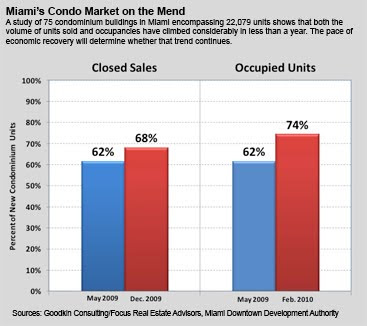
The Residential Closings and Occupancy Study, published in March 2010, updated a similar report issued in June 2009. Both studies examined 75 completed condominium buildings located in a 60-block area in downtown Miami . Many of the buildings adorn prestigious Brickell Avenue and other units overlooking Biscayne Bay .
The study found that in February 2010, 74% of the 22,079 units built since 2003 were occupied versus 62% in May 2009. An average of 345 units were leased monthly last year.
Full-time residents occupy 87% of the 16,415 units. Of those units, a little more than half (52%) are rented. “There’s a younger crowd, new businesses and lots more after hours people,” notes Alyce Robertson, the DDA’s executive director.
Sales also increased. More than 15,000 of the existing units, or 68%, were sold at the end of 2009 compared with 62% in May 2009. Average monthly sales in the downtown Miami area totaled 350 units in the fourth quarter of last year, a whopping gain of more than 200% over the fourth quarter of 2008.
Approximately 7,000 condo units remain on the downtown market. If current trends continue, the study predicts that all of downtown Miami’s existing condo inventory could be occupied within 25 months.
Tempering the exuberance
“There’s been a movement to the downtown area based on affordability that didn’t exist previously,” explains Craig Worley, president of Focus Real Estate Advisors. However, he cautions the projections depend on employment stability and job creation. “We’re not out of the woods yet,” he says.
Other caveats: A significant number of buyers were investors “looking for an appreciation play,” Worley explains, “so potentially a large number of units could be fed back onto the market.” And rental rates across the board generally “don’t provide a positive cash flow to cover homeowner association fees and taxes.”
Jack McCabe, CEO of McCabe Research and Consulting based in Deerfield Beach, Fla., agrees. “When you peel back the skin it isn’t so pretty,” he says. “We’ve seen sales pick up — primarily cash deals to bulk investors and international buyers — at deeply discounted prices. It’s basically a cash buyers’ market.”
McCabe adds that prices have fallen some 50% to 70% to $200 to $250 per sq. ft. from a high of $500 to $600 per sq. ft. at the market’s peak.
Sales of existing condos in Miami increased 46% to 1,920 units sold compared with 1,311 in the first quarter of 2009, according to the Florida Association of Realtors. However, the median price fell 9% to $136,100 compared with $149,000 a year earlier.
Financing hurdles remain
Peter Zalewski, founder of Condo Vultures Realty LLC, a firm specializing in condo sales, research and consulting, reports only 17% of the 713 new condos sold during the first quarter in the greater downtown Miami area obtained financing.
The remaining sales were cash transactions. He estimates that only approximately one out of four transactions involve primary users; the remaining units are sold to speculators with cash. Like many other observers, Zalewski says the impact of the first-time homebuyer tax credit was minimal.
Recently Fannie Mae and Freddie Mac announced plans to ease existing stringent guidelines to provide more financing for Florida’s condo market. In January, Fannie Mae introduced the Special Approval Designation program and assigned a team of six professionals to review existing condo projects that previously failed to qualify for the agency’s financing because of foreclosures , high vacancy rates, unpaid homeowner association fees and other expenses.
If the team awards a building a Special Approval Designation, lenders can originate and deliver mortgages to the agency. “It’s setting the scene,” Zalewski says. “The dividend will be paid in 2011.”
Source: http://www.nuwireinvestor.com/articles/miami-condominiums-see-improving-occupancy-and-sales-transactions-55246.aspx
Written by: Jody Fidler
“We’re coming out of the most prolific overbuilding in the history of Southeast Florida,” says Jonathan Kingsley, executive vice president and managing director at brokerage firm Grubb & Ellis.

The Residential Closings and Occupancy Study, published in March 2010, updated a similar report issued in June 2009. Both studies examined 75 completed condominium buildings located in a 60-block area in downtown Miami . Many of the buildings adorn prestigious Brickell Avenue and other units overlooking Biscayne Bay .
The study found that in February 2010, 74% of the 22,079 units built since 2003 were occupied versus 62% in May 2009. An average of 345 units were leased monthly last year.
Full-time residents occupy 87% of the 16,415 units. Of those units, a little more than half (52%) are rented. “There’s a younger crowd, new businesses and lots more after hours people,” notes Alyce Robertson, the DDA’s executive director.
Sales also increased. More than 15,000 of the existing units, or 68%, were sold at the end of 2009 compared with 62% in May 2009. Average monthly sales in the downtown Miami area totaled 350 units in the fourth quarter of last year, a whopping gain of more than 200% over the fourth quarter of 2008.
Approximately 7,000 condo units remain on the downtown market. If current trends continue, the study predicts that all of downtown Miami’s existing condo inventory could be occupied within 25 months.
Tempering the exuberance
“There’s been a movement to the downtown area based on affordability that didn’t exist previously,” explains Craig Worley, president of Focus Real Estate Advisors. However, he cautions the projections depend on employment stability and job creation. “We’re not out of the woods yet,” he says.
Other caveats: A significant number of buyers were investors “looking for an appreciation play,” Worley explains, “so potentially a large number of units could be fed back onto the market.” And rental rates across the board generally “don’t provide a positive cash flow to cover homeowner association fees and taxes.”
Jack McCabe, CEO of McCabe Research and Consulting based in Deerfield Beach, Fla., agrees. “When you peel back the skin it isn’t so pretty,” he says. “We’ve seen sales pick up — primarily cash deals to bulk investors and international buyers — at deeply discounted prices. It’s basically a cash buyers’ market.”
McCabe adds that prices have fallen some 50% to 70% to $200 to $250 per sq. ft. from a high of $500 to $600 per sq. ft. at the market’s peak.
Sales of existing condos in Miami increased 46% to 1,920 units sold compared with 1,311 in the first quarter of 2009, according to the Florida Association of Realtors. However, the median price fell 9% to $136,100 compared with $149,000 a year earlier.
Financing hurdles remain
Peter Zalewski, founder of Condo Vultures Realty LLC, a firm specializing in condo sales, research and consulting, reports only 17% of the 713 new condos sold during the first quarter in the greater downtown Miami area obtained financing.
The remaining sales were cash transactions. He estimates that only approximately one out of four transactions involve primary users; the remaining units are sold to speculators with cash. Like many other observers, Zalewski says the impact of the first-time homebuyer tax credit was minimal.
Recently Fannie Mae and Freddie Mac announced plans to ease existing stringent guidelines to provide more financing for Florida’s condo market. In January, Fannie Mae introduced the Special Approval Designation program and assigned a team of six professionals to review existing condo projects that previously failed to qualify for the agency’s financing because of foreclosures , high vacancy rates, unpaid homeowner association fees and other expenses.
If the team awards a building a Special Approval Designation, lenders can originate and deliver mortgages to the agency. “It’s setting the scene,” Zalewski says. “The dividend will be paid in 2011.”
Source: http://www.nuwireinvestor.com/articles/miami-condominiums-see-improving-occupancy-and-sales-transactions-55246.aspx
Written by: Jody Fidler
Monday, May 10, 2010
Pending home sales in South Florida jump
Propelled by low prices, attractive interest rates and federal incentives to lock in offers by the month's end, the number of new contracts on South Florida homes soared in April.
Compared with March, pending sales of single-family homes and condominiums increased last month in both Miami-Dade and Broward, mirroring the national upward trend in contracts signed, according to data released Tuesday by the Realtor Association of Greater Miami and the Beaches. Compared with last April, the number skyrocketed.
Pending home sales track signed contracts that haven't yet closed -- a figure that may have been unusually high for April because buyers had to sign contracts by April 30 to qualify for federal tax credits. To finalize the credit -- $8,000 for first-timers, $6,500 for repeat buyers -- they must close by June 30.
The number of pending home sales overall ticked up by 6.6 percent in Miami-Dade in April, with 10,392 compared with 9,751 in March. In Broward, pending home sales increased from 8,173 in March to 8,525 in April, up 4.3 percent.
Those increases represent huge leaps over last year's numbers. In Miami-Dade, pending sales increased 71 percent year over year; the jump was 64 percent in Broward, figures that point to a recovering market, real estate agents and analysts say.
Sales have increased for the past few months as home prices have fallen.
NEARING BOTTOM?
Independent housing analyst Jack McCabe said the market is likely nearing the bottom, but still must deal with foreclosures and short sales, which keep prices low.
``I think we're going to see a pretty decent year as far as sales numbers, but I don't see prices going up,'' he said.
``The state of paralysis, I think, is pretty much over,'' said Terri Bersach, chairman of the association, which released the data with the Southeast Florida Multiple Listing Service.
Nationally, pending home sales increased in March. The index of sales contracts by the National Association of Realtors rose 5.3 percent from February and 21 percent over last March.
DROP PREDICTED
The national association's chief economist, Lawrence Yun, predicted a drop in sales in the near future.
But South Florida agents say they aren't too concerned about the expired credit.
Jo-Ann Forster, a broker associate with Esslinger Wooten Maxwell, said the tax credit was attractive to buyers looking at less expensive properties.
``If you're going to take all of Miami-Dade into consideration, you're going to see a drop-off,'' Forster said. ``If you take our niche markets, I don't think it's going to have a cataclysmic reaction.''
Anthony Askowitz, a broker and owner of two Re/Max offices, said the timing is good because May and June are typically busy sales months.
``If Miami had a season, this is definitely the big season,'' he said.
Source: http://www.miamiherald.com/2010/05/05/1613443/pending-home-sales-jump.html
By HANNAH SAMPSON
hsampson@MiamiHerald.com
Thursday, April 29, 2010
Florida Home Sales Increase for the 19th Straight Month

Florida’s existing home sales rose in March, which means that sales activity has increased in the year-to-year comparison for 19 months, according to the latest housing data released by Florida Realtors.
Existing home sales increased 24 percent last month with a total of 16,294 homes sold statewide compared to 13,090 homes sold in March 2009 (see chart above). Statewide existing home sales last month increased 37 percent over statewide sales activity in February (11,890 homes sold). Also noteworthy: While March’s statewide existing-home median price of $137,000 was down from the same time a year ago, it was 4.3 percent higher than February’s statewide existing-home median price of $131,350.
MP: These recent sales data for Florida paint a much more positive picture of the Florida real estate market than the Case-Shiller home price data released yesterday, which showed annual price declines through February 2010 of -7.7% for Miami and -9.8% for Tampa. For March 2010, the statewide median price decline was only -3% versus March 2009, and the other key variable - home sales - was up by 24% since last March.
Assuming the median home price is not too different than the mean home price, the total housing sales volume increased from about $1.85 billion in March 2009 to about $2.23 billion in March 2010, for a 20.5% increase. If we measured housing market activity like we measured vehicle sales - in unit sales, without regard to price - we would conclude that the Florida housing market is booming, with 19 consecutive monthly increases compared to the same month in the previous year, and a whopping 24% increase from March of last year. And if we measured housing activity like we measure retail sales (total sales volume), we would also conclude that the Florida housing market is doing quite well, with something like a 20% increase in sales volume (assuming the median home price is an accurate estimate of the mean home price).
Isn't that a possible limitation of the Case-Shiller Home Price Index as a measure of the real estate market - it only looks at one of the key housing indicators, price, and completely ignores the other key variable, units sold; and therefore also fails to measure housing sales volume?
Friday, April 23, 2010
Sales Of Previously Owned Homes
FOR MORE INFORMATION GO TO OUR WEBSITE
Sales of previously owned U.S. homes jumped 6.8 percent in March, a national group said Thursday.
Real estate agents have been counting on a spring surge brought on by an expanded and extended federal tax credit for buyers. The March sales pace reached a seasonally adjusted annual rate of 5.35 million units, up from 5.01 million in February and 16.1 percent above the 4.61-million-unit pace in March 2009, according to the National Association of Realtors in Washington.
Lawrence Yun, chief economist for the group, said the federal tax credit that was to expire at the end of this month had been a "resounding success."
Whether home sales will hold up after the expiration remains a question in debate.
"I'm fairly sanguine, frankly," said Michael D. Larson, a housing and interest-rate analyst with Weiss Research. "While the credit expires April 30, more forces are at work here. Home prices are now reasonable in many parts of the country, and financing costs remain low."
The national median home price was $170,700 last month, up 0.4 percent from the same month the prior year, the Realtors group said.
Regionally, sales of previously owned homes rose 6.6 percent in the West, 7.1 percent in the South, 7.2 percent in the Midwest and 6 percent in the East.
Source: http://www.miamiherald.com/2010/04/22/1593001/sales-of-previously-owned-homes.html
By ALEJANDRO LAZO
Los Angeles Times
Subscribe to:
Posts (Atom)