May 30--Nearly 800 Canadians will jam a hotel ballroom near the Toronto airport Sunday to hear the gospel of Florida real estate.
High-end Brazilian buyers prefer to be wooed more intimately -- perhaps at a cocktail party or a small private dinner -- but they are just as pumped.
Lured by rock-bottom prices, international buyers are now flocking to buy Florida properties. It's especially true in countries where the currency is strong against the dollar.
"We're telling Canadians this is a once-in-a-lifetime opportunity -- the perfect storm," said Brian Ellis, who heads Toronto-based Florida Home Finders of Canada. "The prices are just incredible and the Canadian dollar has been so strong."
At least three of five buyers in the Greater Downtown Miami condo market are coming from abroad, estimates Jenny Huertas, international sales director for Condo Vultures, a real estate advisory and research firm.
The stampede from overseas is "kind of like a foreign subsidy helping us resolve our real estate problems," said Peter Zalewski, a Condo Vultures principal. "This time the assistance isn't coming from Washington. It's coming from Caracas, London, Milan, Bogota."
The buying frenzy was set off by developers lowering prices on new units to below what it cost to build in today's market, Huertas said.
"There were many people on the sidelines watching for the floor. In the last three or four months there's the perception that we're there," said developer Edgardo Defortuna, president and chief executive of Fortune International.
CASH CUSTOMERS
Most of the foreigners are cash buyers like Leroy Jean Francois, who has snapped up 47 properties since January for the two real estate firms he works for in France and Switzerland. The plan, he said, is to buy, fix up if necessary, rent out for the next five years, then sell -- for a profit.
The Frenchman has already made a paper profit on a unit he closed on in January at Marquis Residences, a 67-story luxury tower in downtown Miami where prices for a one-bedroom apartment start at $375,000. His unit cost $317 per square foot -- "a great price, incredible," he said.
A recent plunge in the euro -- it's now worth $1.23, down from its high of more than $1.60 in 2008 -- could cool things off a little. To buy a $1 million condo, it now takes around 814,000 euros compared to 625,000 euros under the old exchange rate.
Meantime, prices at Marquis Residences also have strengthened to around $400 per square foot.
But even the declining euro has barely given Francois pause.
"I think the euro will weaken more. But even if the exchange rate is $1 to 1 euro, South Florida real estate is still a great bargain for us," said Francois, who is president of The Bridge, a real estate fund consultancy.
AVERAGE JOES
Luxury condos are once again popular among Latin America buyers who purchase them as investments but also as a home base while their children attend school here, they attend to business interests or escape strife at home.
But for his Canadian buyers, Ellis scours South Florida for condo units at around the $150,000 price point. "We're basically the Wal-Mart. We're for the average Joe."
And these days average Joe Canadian can afford much more. For decades the U.S. dollar was worth more than the Canadian dollar and buying in the U.S. was always more expensive for Canadians. But in September 2007, the Canadian dollar reached parity with the greenback for the first time in 31 years. It fell back again, but now the Canadian loonie, which takes its name from the loon pictured on the one-dollar coin, is near parity at around 95 cents.
So Ellis has been offering his Florida real estate seminars to packed houses in Ontario and is thinking about taking the show on the road to Montreal. There was so much interest in the latest seminar that he had to schedule two sessions for 400 people each this Sunday.
Most of his Canadian buyers are what Ellis calls "end-vestors," meaning they plan on renting a unit out for now with an eye toward using it themselves down the road.
Since Home Finders is licensed as a brokerage only in Canada, it works with Florida brokers who complete the sales and pay the Canadian firm referral fees. By year's end, Ellis said he expects to have facilitated 500 Florida closings.
PRICES HALVED
Though Home Finders is now working with one Sunny Isles Beach property where condos are listed for up to $350,000, the Sun Vista Gardens in Tamarac is a more typical offering.
There, buyers can find a one-bedroom for under $75,000 and a two-bedroom for under $100,000. That same one-bedroom, used to cost $190,000, according to Florida Home Finders' website.
Ellis said he's actually having a hard time coming up with enough Florida properties in the $150,000 range. Of course, he's picky. He's looking for good value, a good location and properties without legal complications. Most of the Canadians want condos, but Ellis said he has some requests for single-family homes.
Though buyers from Europe, Latin America -- most from Argentina, Brazil, Colombia, and Venezuela -- and Canada predominate in the South Florida market, a smattering of Chinese investors and African buyers also are starting to make purchases.
"We recently sold a $7.5 million penthouse at Jade Ocean to a Nigerian buyer," said Defortuna. "They were here and they loved it."
CHINA, TOO
At Fortune's 237-unit Artech building, Defortuna said 11 condos were sold to Chinese investors. Units in the building are selling for almost half of the original asking price.
"I think China is still a marginal market," said Defortuna. "The Chinese are more focused on the West Coast and New York, but small pockets [of Chinese buyers] can make a big difference in a building."
With international offices in Mexico and Argentina, Fortune can tap directly into those markets, and it frequently holds seminars on the legal and financial aspects of owning property in the United States. At one recent event in Buenos Aires there was space for just 200 people, so Fortune decided to charge a $60 fee. "We still had to close reservations," said Defortuna.
One big concern of foreign buyers is what happens to their properties when they lock up after a vacation, said Defortuna. But Fortune International's property management division will take care of things like paying utilities and condo fees -- and even turn over a client's car engine once a week so the battery doesn't die.
A number of local brokerages have country specialists on staff who work with their counterparts abroad to bring in buyers.
Elite Global Reality, for example, has sales associates who specialize in the French, Italian and Chilean markets, said Thiago Costa, executive director and sales associates.
Costa, who is Brazilian, travels frequently to his homeland where local partners have set up meetings with potential buyers in Sao Paulo, Rio de Janeiro or Belo Horizonte who are "willing and able to buy."
He prefers to present one South Florida project at a time to 10 to 20 people at a cocktail party or even a dinner at the home of a potential buyer.
With Miami prices so low, the Brazilian currency (the real) strong, the Brazilian economy robust and real estate prices on the rise in cities like Sao Paulo, where a luxury property might cost $800 to $1,000 per square foot, Brazilians like what they see in South Florida.
'IMPOSSIBLE TO LOSE'
"They feel it's almost impossible to lose money," said Costa.
Africa Israel USA, the New York-based developer of the 292-unit Marquis Residences, also works with the brokerage community in target markets like Venezuela, the South of France, Mexico and Brazil. Working with brokers, it has put on events ranging from fashion shows to invitation-only cocktail parties and dinners, said Lori Odover, the managing director.
"It needs to be someone they know, that they have a one-on-one relationship," she said. So that means even an event at a synagogue or someone's uncle's pool party can be a selling opportunity.
Though most international buyers pay cash, there's an international financing program at Marquis that has proven popular. Some 57 percent of Marquis' foreign buyers have chosen it.
While the program's 45 percent down payment for a five-year ARM seems steep, Bob Wuan, managing director of Americore Mortgage/Vacation Finance, said, "We find international buyers are more than willing to put 50 percent or more down. They want to put money in U.S. real estate as a currency hedge or an inflation hedge."
Meanwhile, Ellis keeps telling Canadians what a great deal Florida is: "We believe Florida is in for quite a rebound. We just don't know when."
Source: http://www.americanchronicle.com/articles/yb/145584684
By Mimi Whitefield, The Miami Herald
The Criscitos has been selling South Florida luxury and commercial real estate for over a decade and has sold over $1 billion dollars of property. They work as a multi-lingual team speaking english, Spanish, Italian and Portuguese. They carved out a niche as a leading boutique real estate company with two distinct divisions -residential and commercial- both personally overseeing by Marcela and Anthony Criscito.
Monday, May 31, 2010


Thursday, May 27, 2010
Home purchase negotiations shouldn't end at price
Buyers and sellers who haggle over price alone could be leaving a lot on the table.
The purchase price is only one part of the transaction. Everything in a real-estate deal is open to negotiation, and sometimes price isn't the most important factor.
A buyer might be willing to pay a little more to move into the house within 30 days, for example, instead of waiting until the seller finds another place to live. Similarly, a seller might take less if he could stay longer.
Which appliances stay with the house can sometimes be a sticking point that makes or breaks a deal. Whether or not the seller will help pay the buyer's closing costs is another. If the seller provides a so-called "warranty" is another.
Here are some of the bargaining points each side should consider:
• Earnest money. Buyers are usually asked to attach a check to an offer. But such a deposit also can be used to compensate the seller if the purchaser withdraws from the deal without a legally suitable reason.
Consequently, the seller should seek as large a deposit as possible. It may provide some bargaining room later if you need it. And besides, you can always go lower if a good offer presents itself.
If the closing is set far into the future — say, anywhere from three to six months — you might want to demand an even larger deposit because your home will, in effect, be off the market for that prolonged period.
Buyers, on the other hand, want to be certain the full return of the deposit is tied to contingencies in the contract.
• Financing. Unless they are for all cash, almost all offers are predicated upon the buyer's ability to secure funding. But the seller should be certain the financing contingency is based on reasonable economic conditions.
A financing clause is usually in two parts: 1) that the buyer secures funding within a certain number of days and 2) that the mortgage rate will be no more than a certain percentage. In each instance, your agent should be able to advise you about what is reasonable for current economic conditions.
But seller beware: Make sure that the buyer applies for a mortgage right away so that if he can't qualify, the house can be put back on the market without too much time being lost. Consequently, the timing portion of this condition shouldn't be too long, certainly no longer than a few weeks at the most.
Also, if the rate portion of this contingency is set too low, the house might be under contract but the contract may be all but worthless because there's no way any buyer will find a rate that far below the market.
If the offer is for cash, the buyer may want to seek a somewhat lower price because the sale is all but guaranteed to go through.
• Backups. Even though a seller has accepted an offer, he should entertain others as backup contracts in case the first one goes sour. But to give yourself the opportunity to select the next-best offer, or hunt for even better offers, don't accept other contracts in any particular order.
• Inspections. As a marketing tool, sellers sometimes hire an independent third-party inspector to give their homes a clean bill of health. But it is usually the buyer who wants the house looked over from top to bottom. That way, if the water heater is on its deathbed or the heat exchanger is cracked, they can use the inspector's findings to renegotiate.
Also, just in case the findings are not to his liking, the buyer will want his deposit returned promptly and in full.
At the same time, the seller should require that the inspection be done promptly so the property is not put in limbo.
• Closing costs. Sellers often pay part — and sometimes all — of their buyers' escrow fees, things like a title search, termite inspection, survey and the like. The exact amount or percentage is usually dictated by local custom. But it's all open to negotiation.
• Fixtures. Items such as wall-to-wall carpeting, window treatments and ranges are not part of the structure. But they are attached to it so they are generally considered to be fixtures that convey with the property. But these and plenty of other items can be key bargaining tools. And whatever you agree on, make sure it is spelled out clearly in the contract.
The seller will want to list what does not convey with title as "not included in the sale," and the buyer will want to list everything that stays with the property.
Source: http://www.sun-sentinel.com/business/realestate/fl-home-price-haggling,0,174086.story
By Lew Sichelman
Los Angeles Times
The purchase price is only one part of the transaction. Everything in a real-estate deal is open to negotiation, and sometimes price isn't the most important factor.
A buyer might be willing to pay a little more to move into the house within 30 days, for example, instead of waiting until the seller finds another place to live. Similarly, a seller might take less if he could stay longer.
Which appliances stay with the house can sometimes be a sticking point that makes or breaks a deal. Whether or not the seller will help pay the buyer's closing costs is another. If the seller provides a so-called "warranty" is another.
Here are some of the bargaining points each side should consider:
• Earnest money. Buyers are usually asked to attach a check to an offer. But such a deposit also can be used to compensate the seller if the purchaser withdraws from the deal without a legally suitable reason.
Consequently, the seller should seek as large a deposit as possible. It may provide some bargaining room later if you need it. And besides, you can always go lower if a good offer presents itself.
If the closing is set far into the future — say, anywhere from three to six months — you might want to demand an even larger deposit because your home will, in effect, be off the market for that prolonged period.
Buyers, on the other hand, want to be certain the full return of the deposit is tied to contingencies in the contract.
• Financing. Unless they are for all cash, almost all offers are predicated upon the buyer's ability to secure funding. But the seller should be certain the financing contingency is based on reasonable economic conditions.
A financing clause is usually in two parts: 1) that the buyer secures funding within a certain number of days and 2) that the mortgage rate will be no more than a certain percentage. In each instance, your agent should be able to advise you about what is reasonable for current economic conditions.
But seller beware: Make sure that the buyer applies for a mortgage right away so that if he can't qualify, the house can be put back on the market without too much time being lost. Consequently, the timing portion of this condition shouldn't be too long, certainly no longer than a few weeks at the most.
Also, if the rate portion of this contingency is set too low, the house might be under contract but the contract may be all but worthless because there's no way any buyer will find a rate that far below the market.
If the offer is for cash, the buyer may want to seek a somewhat lower price because the sale is all but guaranteed to go through.
• Backups. Even though a seller has accepted an offer, he should entertain others as backup contracts in case the first one goes sour. But to give yourself the opportunity to select the next-best offer, or hunt for even better offers, don't accept other contracts in any particular order.
• Inspections. As a marketing tool, sellers sometimes hire an independent third-party inspector to give their homes a clean bill of health. But it is usually the buyer who wants the house looked over from top to bottom. That way, if the water heater is on its deathbed or the heat exchanger is cracked, they can use the inspector's findings to renegotiate.
Also, just in case the findings are not to his liking, the buyer will want his deposit returned promptly and in full.
At the same time, the seller should require that the inspection be done promptly so the property is not put in limbo.
• Closing costs. Sellers often pay part — and sometimes all — of their buyers' escrow fees, things like a title search, termite inspection, survey and the like. The exact amount or percentage is usually dictated by local custom. But it's all open to negotiation.
• Fixtures. Items such as wall-to-wall carpeting, window treatments and ranges are not part of the structure. But they are attached to it so they are generally considered to be fixtures that convey with the property. But these and plenty of other items can be key bargaining tools. And whatever you agree on, make sure it is spelled out clearly in the contract.
The seller will want to list what does not convey with title as "not included in the sale," and the buyer will want to list everything that stays with the property.
Source: http://www.sun-sentinel.com/business/realestate/fl-home-price-haggling,0,174086.story
By Lew Sichelman
Los Angeles Times
Wednesday, May 26, 2010
South Florida Homes - and prices - rise
After nearly three years of freefall, South Florida single-family home prices tried something new in April: They went up.
In a sign that the ailing real estate market could be heading in a healthier direction, the median sale price of existing homes in Miami-Dade and Broward increased compared with last April, according to data released Monday by the trade group Florida Realtors.
Home sales also crept up, fueled by bargains on troubled properties, low mortgage rates and a deadline for thousands of dollars in tax credits.
``There's no question that the market has been strengthening,'' said Ron Shuffield, president of Esslinger-Wooten-Maxwell Realtors.
In Miami-Dade, the year-over-year median home price increased by 8 percent to $192,000, while the jump was 7 percent in Broward, to $204,300. Existing Miami-Dade home sales rose 7 percent over last April to 594. In Broward, sales increased 11 percent to 766.
Condo sales had big jumps over last year, but with plenty of inventory still to choose from, prices continued to fall. In Miami-Dade, 723 units sold, a 33 percent increase over the same time a year ago. But the median price dropped 3 percent to $130,000. Broward condo prices dropped a percent to $79,300, with 1,077 selling -- an increase of 30 percent over April 2009.
All this follows last week's positive news on the job front. Florida's unemployment rate dropped to 12 percent in April after 49 months of increases.
``It is a lot more exciting now,'' said Jay Reichbaum, general manager at Jeanne Baker International Realty in Coconut Grove. ``Things are definitely looking a little brighter.''
Still, he called the mood ``hopefully optimistic'' rather than all-out celebratory. ``Most of us who've been doing this for awhile feel like we probably won't get back to a real market until 2011 at least.''
Foreign buyers, mostly Canadians armed with cash, have been driving sales in Hollywood, Hallandale Beach and Sunny Isles Beach for Realtor Genevieve Bouchard.
``It was really, really great,'' said Bouchard, who said the big sellers are condos between $150,000-$300,000. ``I wish all my months were like that.''
Nationally, home sales outpaced expectations for April with the temporary boost of an $8,000 tax credit for first-time buyers and $6,500 credit for repeat buyers. The deadline to sign a contract was April 30; buyers must close by the end of June.
The National Association of Realtors said Monday that sales of previously owned homes rose 7.6 percent to a seasonally adjusted annual rate of 5.77 million, the best showing in five months.
Home prices also increased from a year ago, with the median price up 4 percent to $173,100.
If you put a microscope to the numbers, the month-to-month figures show less clarity. April's numbers were either only slightly better or worse than March's. Broward single-family home sales were up 4 percent from March, while prices dropped 4.5 percent. Miami-Dade sales dipped 8.5 percent and prices were down nearly 3 percent.
Miami-Dade condo sales were down 13 percent, with prices down 6 percent from March. Condo sales in Broward dropped 5.5 percent month over month, though prices increased almost 8 percent.
Expert opinions on Monday's news ranged from skeptical to the ``I told you so'' variety.
``I think it's a blip,'' said independent housing analyst Jack McCabe, CEO of McCabe Research & Consulting. ``A lot of times when we compare these monthly numbers from the Realtors association to a year ago, they're highly volatile.''
He pointed to foreclosures that haven't hit the market and predicted a drop in sales later this year once all the tax credit-fueled purchases close.
But real estate analyst, appraiser and advisor Michael Y. Cannon said he was wasn't surprised by the increase in sales and prices.
``The market is coming back to its equilibrium,'' he said.
Cannon, executive director of Integra Realty Resources -- Miami, said some markets -- Coral Gables, Miami Beach and part of Coconut Grove, for example -- have kept their prices up, and even some investors are finding value in flipping foreclosures.
EWM's Shuffield said it is too early to predict whether sales prices will continue to increase, but said the figures should bring confidence to the homeowners.
``I don't think anybody is anticipating that we're going to see peak prices again anytime soon,'' he said. ``But I think if we can just begin to get back to a normal increase of 4, 5, 6 percent annually in value, then people would be very pleased.''
Physician's assistant Krysten Riordan ``probably looked at close to 100 houses'' before signing a contract for a four-bedroom home in Davie in April. She's waiting for bank approval.
Riordan, 32, said low interest rates and fair prices spurred her to make her move.
``For me, I think everything fell into place at the right time.''
Source: http://www.miamiherald.com/2010/05/24/1646315/home-sweet-home-with-rising-sales.html
BY HANNAH SAMPSON
hsampson@MiamiHerald.com
In a sign that the ailing real estate market could be heading in a healthier direction, the median sale price of existing homes in Miami-Dade and Broward increased compared with last April, according to data released Monday by the trade group Florida Realtors.
Home sales also crept up, fueled by bargains on troubled properties, low mortgage rates and a deadline for thousands of dollars in tax credits.
``There's no question that the market has been strengthening,'' said Ron Shuffield, president of Esslinger-Wooten-Maxwell Realtors.
In Miami-Dade, the year-over-year median home price increased by 8 percent to $192,000, while the jump was 7 percent in Broward, to $204,300. Existing Miami-Dade home sales rose 7 percent over last April to 594. In Broward, sales increased 11 percent to 766.
Condo sales had big jumps over last year, but with plenty of inventory still to choose from, prices continued to fall. In Miami-Dade, 723 units sold, a 33 percent increase over the same time a year ago. But the median price dropped 3 percent to $130,000. Broward condo prices dropped a percent to $79,300, with 1,077 selling -- an increase of 30 percent over April 2009.
All this follows last week's positive news on the job front. Florida's unemployment rate dropped to 12 percent in April after 49 months of increases.
``It is a lot more exciting now,'' said Jay Reichbaum, general manager at Jeanne Baker International Realty in Coconut Grove. ``Things are definitely looking a little brighter.''
Still, he called the mood ``hopefully optimistic'' rather than all-out celebratory. ``Most of us who've been doing this for awhile feel like we probably won't get back to a real market until 2011 at least.''
Foreign buyers, mostly Canadians armed with cash, have been driving sales in Hollywood, Hallandale Beach and Sunny Isles Beach for Realtor Genevieve Bouchard.
``It was really, really great,'' said Bouchard, who said the big sellers are condos between $150,000-$300,000. ``I wish all my months were like that.''
Nationally, home sales outpaced expectations for April with the temporary boost of an $8,000 tax credit for first-time buyers and $6,500 credit for repeat buyers. The deadline to sign a contract was April 30; buyers must close by the end of June.
The National Association of Realtors said Monday that sales of previously owned homes rose 7.6 percent to a seasonally adjusted annual rate of 5.77 million, the best showing in five months.
Home prices also increased from a year ago, with the median price up 4 percent to $173,100.
If you put a microscope to the numbers, the month-to-month figures show less clarity. April's numbers were either only slightly better or worse than March's. Broward single-family home sales were up 4 percent from March, while prices dropped 4.5 percent. Miami-Dade sales dipped 8.5 percent and prices were down nearly 3 percent.
Miami-Dade condo sales were down 13 percent, with prices down 6 percent from March. Condo sales in Broward dropped 5.5 percent month over month, though prices increased almost 8 percent.
Expert opinions on Monday's news ranged from skeptical to the ``I told you so'' variety.
``I think it's a blip,'' said independent housing analyst Jack McCabe, CEO of McCabe Research & Consulting. ``A lot of times when we compare these monthly numbers from the Realtors association to a year ago, they're highly volatile.''
He pointed to foreclosures that haven't hit the market and predicted a drop in sales later this year once all the tax credit-fueled purchases close.
But real estate analyst, appraiser and advisor Michael Y. Cannon said he was wasn't surprised by the increase in sales and prices.
``The market is coming back to its equilibrium,'' he said.
Cannon, executive director of Integra Realty Resources -- Miami, said some markets -- Coral Gables, Miami Beach and part of Coconut Grove, for example -- have kept their prices up, and even some investors are finding value in flipping foreclosures.
EWM's Shuffield said it is too early to predict whether sales prices will continue to increase, but said the figures should bring confidence to the homeowners.
``I don't think anybody is anticipating that we're going to see peak prices again anytime soon,'' he said. ``But I think if we can just begin to get back to a normal increase of 4, 5, 6 percent annually in value, then people would be very pleased.''
Physician's assistant Krysten Riordan ``probably looked at close to 100 houses'' before signing a contract for a four-bedroom home in Davie in April. She's waiting for bank approval.
Riordan, 32, said low interest rates and fair prices spurred her to make her move.
``For me, I think everything fell into place at the right time.''
Source: http://www.miamiherald.com/2010/05/24/1646315/home-sweet-home-with-rising-sales.html
BY HANNAH SAMPSON
hsampson@MiamiHerald.com
Monday, May 24, 2010
Miami Condominiums See Improving Occupancy And Sales Transactions
Clouds are lifting over Miami’s beleaguered condo market following a boom-and-bust cycle of epic proportions. According to a recent study commissioned by the City of Miami’s Downtown Development Authority (DDA) and conducted in partnership with Goodkin Consulting and Focus Real Estate Advisors LLC, condo sales and occupancy rates are on the rise.
“We’re coming out of the most prolific overbuilding in the history of Southeast Florida,” says Jonathan Kingsley, executive vice president and managing director at brokerage firm Grubb & Ellis.
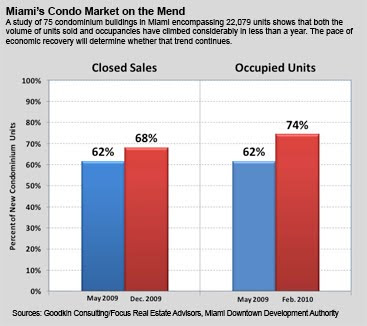
The Residential Closings and Occupancy Study, published in March 2010, updated a similar report issued in June 2009. Both studies examined 75 completed condominium buildings located in a 60-block area in downtown Miami . Many of the buildings adorn prestigious Brickell Avenue and other units overlooking Biscayne Bay .
The study found that in February 2010, 74% of the 22,079 units built since 2003 were occupied versus 62% in May 2009. An average of 345 units were leased monthly last year.
Full-time residents occupy 87% of the 16,415 units. Of those units, a little more than half (52%) are rented. “There’s a younger crowd, new businesses and lots more after hours people,” notes Alyce Robertson, the DDA’s executive director.
Sales also increased. More than 15,000 of the existing units, or 68%, were sold at the end of 2009 compared with 62% in May 2009. Average monthly sales in the downtown Miami area totaled 350 units in the fourth quarter of last year, a whopping gain of more than 200% over the fourth quarter of 2008.
Approximately 7,000 condo units remain on the downtown market. If current trends continue, the study predicts that all of downtown Miami’s existing condo inventory could be occupied within 25 months.
Tempering the exuberance
“There’s been a movement to the downtown area based on affordability that didn’t exist previously,” explains Craig Worley, president of Focus Real Estate Advisors. However, he cautions the projections depend on employment stability and job creation. “We’re not out of the woods yet,” he says.
Other caveats: A significant number of buyers were investors “looking for an appreciation play,” Worley explains, “so potentially a large number of units could be fed back onto the market.” And rental rates across the board generally “don’t provide a positive cash flow to cover homeowner association fees and taxes.”
Jack McCabe, CEO of McCabe Research and Consulting based in Deerfield Beach, Fla., agrees. “When you peel back the skin it isn’t so pretty,” he says. “We’ve seen sales pick up — primarily cash deals to bulk investors and international buyers — at deeply discounted prices. It’s basically a cash buyers’ market.”
McCabe adds that prices have fallen some 50% to 70% to $200 to $250 per sq. ft. from a high of $500 to $600 per sq. ft. at the market’s peak.
Sales of existing condos in Miami increased 46% to 1,920 units sold compared with 1,311 in the first quarter of 2009, according to the Florida Association of Realtors. However, the median price fell 9% to $136,100 compared with $149,000 a year earlier.
Financing hurdles remain
Peter Zalewski, founder of Condo Vultures Realty LLC, a firm specializing in condo sales, research and consulting, reports only 17% of the 713 new condos sold during the first quarter in the greater downtown Miami area obtained financing.
The remaining sales were cash transactions. He estimates that only approximately one out of four transactions involve primary users; the remaining units are sold to speculators with cash. Like many other observers, Zalewski says the impact of the first-time homebuyer tax credit was minimal.
Recently Fannie Mae and Freddie Mac announced plans to ease existing stringent guidelines to provide more financing for Florida’s condo market. In January, Fannie Mae introduced the Special Approval Designation program and assigned a team of six professionals to review existing condo projects that previously failed to qualify for the agency’s financing because of foreclosures , high vacancy rates, unpaid homeowner association fees and other expenses.
If the team awards a building a Special Approval Designation, lenders can originate and deliver mortgages to the agency. “It’s setting the scene,” Zalewski says. “The dividend will be paid in 2011.”
Source: http://www.nuwireinvestor.com/articles/miami-condominiums-see-improving-occupancy-and-sales-transactions-55246.aspx
Written by: Jody Fidler
“We’re coming out of the most prolific overbuilding in the history of Southeast Florida,” says Jonathan Kingsley, executive vice president and managing director at brokerage firm Grubb & Ellis.

The Residential Closings and Occupancy Study, published in March 2010, updated a similar report issued in June 2009. Both studies examined 75 completed condominium buildings located in a 60-block area in downtown Miami . Many of the buildings adorn prestigious Brickell Avenue and other units overlooking Biscayne Bay .
The study found that in February 2010, 74% of the 22,079 units built since 2003 were occupied versus 62% in May 2009. An average of 345 units were leased monthly last year.
Full-time residents occupy 87% of the 16,415 units. Of those units, a little more than half (52%) are rented. “There’s a younger crowd, new businesses and lots more after hours people,” notes Alyce Robertson, the DDA’s executive director.
Sales also increased. More than 15,000 of the existing units, or 68%, were sold at the end of 2009 compared with 62% in May 2009. Average monthly sales in the downtown Miami area totaled 350 units in the fourth quarter of last year, a whopping gain of more than 200% over the fourth quarter of 2008.
Approximately 7,000 condo units remain on the downtown market. If current trends continue, the study predicts that all of downtown Miami’s existing condo inventory could be occupied within 25 months.
Tempering the exuberance
“There’s been a movement to the downtown area based on affordability that didn’t exist previously,” explains Craig Worley, president of Focus Real Estate Advisors. However, he cautions the projections depend on employment stability and job creation. “We’re not out of the woods yet,” he says.
Other caveats: A significant number of buyers were investors “looking for an appreciation play,” Worley explains, “so potentially a large number of units could be fed back onto the market.” And rental rates across the board generally “don’t provide a positive cash flow to cover homeowner association fees and taxes.”
Jack McCabe, CEO of McCabe Research and Consulting based in Deerfield Beach, Fla., agrees. “When you peel back the skin it isn’t so pretty,” he says. “We’ve seen sales pick up — primarily cash deals to bulk investors and international buyers — at deeply discounted prices. It’s basically a cash buyers’ market.”
McCabe adds that prices have fallen some 50% to 70% to $200 to $250 per sq. ft. from a high of $500 to $600 per sq. ft. at the market’s peak.
Sales of existing condos in Miami increased 46% to 1,920 units sold compared with 1,311 in the first quarter of 2009, according to the Florida Association of Realtors. However, the median price fell 9% to $136,100 compared with $149,000 a year earlier.
Financing hurdles remain
Peter Zalewski, founder of Condo Vultures Realty LLC, a firm specializing in condo sales, research and consulting, reports only 17% of the 713 new condos sold during the first quarter in the greater downtown Miami area obtained financing.
The remaining sales were cash transactions. He estimates that only approximately one out of four transactions involve primary users; the remaining units are sold to speculators with cash. Like many other observers, Zalewski says the impact of the first-time homebuyer tax credit was minimal.
Recently Fannie Mae and Freddie Mac announced plans to ease existing stringent guidelines to provide more financing for Florida’s condo market. In January, Fannie Mae introduced the Special Approval Designation program and assigned a team of six professionals to review existing condo projects that previously failed to qualify for the agency’s financing because of foreclosures , high vacancy rates, unpaid homeowner association fees and other expenses.
If the team awards a building a Special Approval Designation, lenders can originate and deliver mortgages to the agency. “It’s setting the scene,” Zalewski says. “The dividend will be paid in 2011.”
Source: http://www.nuwireinvestor.com/articles/miami-condominiums-see-improving-occupancy-and-sales-transactions-55246.aspx
Written by: Jody Fidler
Thursday, May 20, 2010
What to watch for when buying a vacant home
When it comes to the housing market for foreclosures - buyer beware.
"One mistake that we see all the time is buyers going in and assuming all the mechanicals are working," said Brandon T. Johnson, president of GTJ Consulting in Roseville, Mich. "You have to be careful you don't get burned that way."
Johnson's company maintains foreclosed homes for a number of lenders, Realtors and Freddie Mac. He said the term "as is" shouldn't scare buyers off as long as they know what it means. He recommends that buyers get private inspections on houses they want to buy to avoid surprises such as missing plumbing or water damage.
Here's a list of 10 things to watch for in foreclosed or vacant homes from Ross Kollenberg, mitigation and construction manager for On-Site Specialty Cleaning & Restoration in Troy, Mich:
1. Air quality. This tells a lot about the home's condition. Include air and surface testing in your home inspection. It is a few hundred dollars well spent.
2. Black cobwebs, greasy gray residue on walls and/or a strong oily odor. This is soot damage, which requires professional cleaning, and points to a malfunctioning furnace. It also could be a tip-off that the home had a fire.
3. Discolored subflooring. From the basement, check the subflooring above for stains and small holes, both caused by mold.
4. An older home with extensive renovations. Check with the city for permits: You'll get remodeling details. If asbestos or lead paint is present and has been disturbed, be sure it's been remediated by a certified specialist. It the home has four or five major changes, it may not be up to code, and that could mean extensive fixes for the next owner.
5. Peeling, bubbling, and discolored paint; swelling in walls or ceilings (especially around kitchens and bathrooms); a musty odor: All indicate water damage and, potentially, the presence of moisture and mold.
6. Missing sinks, toilets and other fixtures. Sometimes the previous owner will take the fixtures with them, but won't shut off the pipes or will rip fixtures from the wall. If a pipe was cracked during the fixture removal, it could start a slow leak in the wall that isn't easily seen. Make sure those fixtures have been properly removed and not ripped from walls and floors.
7. Fungus growth inside cabinets, behind drawers and built-ins. That could mean there has been water damage. Since water falls down, look for the source above the mold. One trick inspectors use to determine whether there could be hidden water damage is to pull out the kitchen drawers and look inside to see whether the back wall has been rebuilt. If it has, that could mean water damage has been covered up.
8. Excessive painting of every nook, cranny, door and floor. The seller may be covering up mold. "When you go do a home that is 'landlord white' and the trim is flat, we tell people there is a reason the house was painted this way," Kollenberg said. "When we see it is over everything, it is a tip-off that it is just covering something up."
9. Unheated house in winter months. If the home has been properly winterized, there's no need for heat. If not, pipes will burst and cause water damage. The bulk of houses Kollenberg sees were not properly winterized and had a pipe break or water damage.
10. Blocked drains or pipes. These will cause future problems and may have already created sewage backups. Check for a telltale water ring in the basement, Kollenberg said.
Read more: http://www.miamiherald.com/2010/05/20/1638832/what-to-watch-for-when-buying.html#ixzz0oUcH6vnI
"One mistake that we see all the time is buyers going in and assuming all the mechanicals are working," said Brandon T. Johnson, president of GTJ Consulting in Roseville, Mich. "You have to be careful you don't get burned that way."
Johnson's company maintains foreclosed homes for a number of lenders, Realtors and Freddie Mac. He said the term "as is" shouldn't scare buyers off as long as they know what it means. He recommends that buyers get private inspections on houses they want to buy to avoid surprises such as missing plumbing or water damage.
Here's a list of 10 things to watch for in foreclosed or vacant homes from Ross Kollenberg, mitigation and construction manager for On-Site Specialty Cleaning & Restoration in Troy, Mich:
1. Air quality. This tells a lot about the home's condition. Include air and surface testing in your home inspection. It is a few hundred dollars well spent.
2. Black cobwebs, greasy gray residue on walls and/or a strong oily odor. This is soot damage, which requires professional cleaning, and points to a malfunctioning furnace. It also could be a tip-off that the home had a fire.
3. Discolored subflooring. From the basement, check the subflooring above for stains and small holes, both caused by mold.
4. An older home with extensive renovations. Check with the city for permits: You'll get remodeling details. If asbestos or lead paint is present and has been disturbed, be sure it's been remediated by a certified specialist. It the home has four or five major changes, it may not be up to code, and that could mean extensive fixes for the next owner.
5. Peeling, bubbling, and discolored paint; swelling in walls or ceilings (especially around kitchens and bathrooms); a musty odor: All indicate water damage and, potentially, the presence of moisture and mold.
6. Missing sinks, toilets and other fixtures. Sometimes the previous owner will take the fixtures with them, but won't shut off the pipes or will rip fixtures from the wall. If a pipe was cracked during the fixture removal, it could start a slow leak in the wall that isn't easily seen. Make sure those fixtures have been properly removed and not ripped from walls and floors.
7. Fungus growth inside cabinets, behind drawers and built-ins. That could mean there has been water damage. Since water falls down, look for the source above the mold. One trick inspectors use to determine whether there could be hidden water damage is to pull out the kitchen drawers and look inside to see whether the back wall has been rebuilt. If it has, that could mean water damage has been covered up.
8. Excessive painting of every nook, cranny, door and floor. The seller may be covering up mold. "When you go do a home that is 'landlord white' and the trim is flat, we tell people there is a reason the house was painted this way," Kollenberg said. "When we see it is over everything, it is a tip-off that it is just covering something up."
9. Unheated house in winter months. If the home has been properly winterized, there's no need for heat. If not, pipes will burst and cause water damage. The bulk of houses Kollenberg sees were not properly winterized and had a pipe break or water damage.
10. Blocked drains or pipes. These will cause future problems and may have already created sewage backups. Check for a telltale water ring in the basement, Kollenberg said.
Read more: http://www.miamiherald.com/2010/05/20/1638832/what-to-watch-for-when-buying.html#ixzz0oUcH6vnI
Wednesday, May 19, 2010
Sales pick up at Miami's Canyon Ranch
Canyon Ranch Living, a luxury wellness hotel and condo development in Miami that has been heavily targeting New York City buyers, sold 49 condo units in the first quarter of the year, spurring optimism that the 1-million-square-foot property is catching on with buyers, according to Mel Zuckerman, the founder and chairman of Canyon Ranch. The complex contains 430 condo units and 150 hotel rooms, as well as a 70,000-square-foot spa. An affiliate company of Lehman Brothers Holdings took ownership of the property in November 2009 for $291 million. So far, 88 units have sold.
Source: http://therealdeal.com/miami/articles/sales-pick-up-at-wellness-residential-complex-in-miami-canyon-ranch
Source: http://therealdeal.com/miami/articles/sales-pick-up-at-wellness-residential-complex-in-miami-canyon-ranch
Monday, May 17, 2010
Cash still king in condo buys
Cash continues to be king when it comes to buying condos.
A new report by Condo Vultures LLC finds that buyers paid cash for nearly 600 units in 29 projects in the greater downtown Miami area from January through March. Fewer than 120 units in 19 projects were financed, according to the Bal Harbour-based real estate consultancy.
"Even though the U.S. government is encouraging lenders to once again finance condo purchases, the results have not been impressive in South Florida," said Peter Zalewski, a principal with Condo Vultures. "Many lenders claim to be willing to consider writing loans for buyers of condominiums, but the end results simply do not support that.”
The report found buyers obtained nearly three-dozen mortgages – the greatest number in the downtown market – in Icon Brickell. Earlier this month, about half of the 1,800 units in the three-tower complex were handed back to the lender.
The next-highest concentration of financed mortgages was at 500 Brickell, across the street from Icon Brickell, according to the report.
The Ivy condominium, on the north bank of the Miami River, rounded out the top three.
Fannie Mae has been working to easing certification guidelines and has created a special team to review applications for new Florida projects seeking approval.
Fannie Mae approved 70 Florida condominiums in the first four months of the year, after approving 146 projects in the state in 2009. That’s significantly better than in 2008 when no Florida condo projects were granted Fannie Mae approval, according to the report.
Source: http://www.bizjournals.com/southflorida/stories/2010/05/17/daily17.html
A new report by Condo Vultures LLC finds that buyers paid cash for nearly 600 units in 29 projects in the greater downtown Miami area from January through March. Fewer than 120 units in 19 projects were financed, according to the Bal Harbour-based real estate consultancy.
"Even though the U.S. government is encouraging lenders to once again finance condo purchases, the results have not been impressive in South Florida," said Peter Zalewski, a principal with Condo Vultures. "Many lenders claim to be willing to consider writing loans for buyers of condominiums, but the end results simply do not support that.”
The report found buyers obtained nearly three-dozen mortgages – the greatest number in the downtown market – in Icon Brickell. Earlier this month, about half of the 1,800 units in the three-tower complex were handed back to the lender.
The next-highest concentration of financed mortgages was at 500 Brickell, across the street from Icon Brickell, according to the report.
The Ivy condominium, on the north bank of the Miami River, rounded out the top three.
Fannie Mae has been working to easing certification guidelines and has created a special team to review applications for new Florida projects seeking approval.
Fannie Mae approved 70 Florida condominiums in the first four months of the year, after approving 146 projects in the state in 2009. That’s significantly better than in 2008 when no Florida condo projects were granted Fannie Mae approval, according to the report.
Source: http://www.bizjournals.com/southflorida/stories/2010/05/17/daily17.html
Subscribe to:
Posts (Atom)